
Fiscal credibility and the cost of sovereign debt in the Eurozone
Long-term government bond yields rose in tandem across the major advanced economies in autumn 2026, in the absence of a sovereign default or banking crisis to explain the increase. Spain remains in a more favourable position than most of its larger eurozone peers, although the durability of this advantage remains uncertain.
Abstract: The normalisation of interest rates, the withdrawal of central banks as buyers and the deterioration of fiscal outlooks have raised market sensitivity to sovereign risk, pointing to a structural shift in governments’ financing conditions. Because only a fraction of the debt portfolio is refinanced each year, the higher cost reaches public budgets gradually, delaying any adjustments. In the eurozone, France demonstrates that fiscal risk is no longer confined to the periphery: French 10-year bond yields reached 5.14% in October 2026, the highest since 2002, and spread over the Bund exceeded those of Italy and Spain. The ECB’s Transmission Protection Instrument (TPI) requires compliance with the European fiscal framework, which limits its usefulness for a country with France’s fiscal record. In Spain, the debt ratio is falling and the spread over the Bund remains contained, but the average cost of the debt portfolio keeps rising as maturing issues are replaced at current rates. Interest payments are projected to grow by about 50% through 2030 even if official rates do not rise further. Preserving room to respond to the next shock will require a credible medium-term fiscal strategy.
Introduction: From warning to symptom
For fifteen years, it has been predicted that the sovereign debt market would eventually collapse. The fall of 2026 did not bring that collapse, but it did bring more than just a warning, with simultaneous episodes of tension in the long-term segments of the four largest sovereign yield curves in the developed world. The difference matters. A recurring prophecy can be discounted, but a symptom cannot. Between September and October 2026, the 30-year British bond exceeded 6% for the first time since 1998, the 10-year U.S. bond reached levels not seen since 2002, the 10-year Japanese bond crossed the 3% mark for the first time since 1996, and the 10-year French bond hit 24-year highs. None of these movements were triggered by a banking crisis, a default, or a demand shock. They were driven by doubts about governments’ ability to sustain their fiscal trajectories at the interest rates the market is demanding today.
The accounting cost of this shift has already been estimated. Funcas, AIReF, and research firms have quantified how much the normalization of interest rates will add to the interest bill in the coming fiscal years. The problem addressed in this article is a longer-standing one. It involves trying to clarify what sustainability means when the initial financial position is weak, the overall fiscal buffer has disappeared, and the institutional buyer that absorbed supply for a decade—the central bank—is pulling back. Debt sustainability has ceased to be an accounting problem and has become a problem of self-fulfilling expectations. As long as nominal growth exceeds the average cost of debt, the ratio falls almost on its own, creating the illusion that any level of debt appears sustainable. When that gap narrows, sustainability comes to depend on the market continuing to believe in it—and, therefore, on it being a problem that can be reversed in the short term.
Throughout this article, three distinct aspects of this issue are addressed. First, the synchronized nature of the 2026 tensions and what they reveal about the structural demand for long-term debt. Second, the economic mechanism that turns a rate hike into a sustainability problem, with special attention to the role of the average maturity of debt. Third, the case of Spain, where the relative position is currently favorable, and for that very reason it is worth examining what it depends on.
Fall 2026: Anatomy of a synchronized tension
What characterizes the unfolding episode in the fall of 2026 is not the level of interest rates, but their simultaneity across economies with different cyclical and monetary positions. The United Kingdom, the United States, and Japan do not share a cycle, a central bank, or a currency. They share long-term maturities being sold off at the same time.
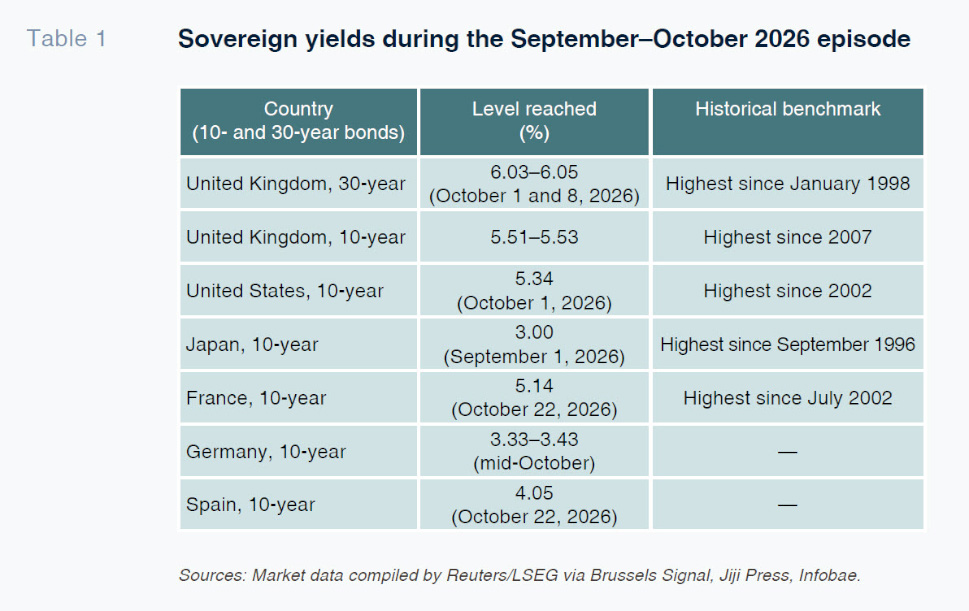
Three features deserve special attention. The first is that the tension is concentrated in the long end of the curve. The British case is illustrative because the spread between 30-year and 10-year bonds widened, ruling out a reassessment of short-term monetary policy as the sole explanation. What rose was the term premium—that is, the compensation required for assuming duration risk.
The second is that the trigger was fiscal, not monetary. In Japan, the sell-off followed budget requests for fiscal year 2027 totaling nearly 143 trillion yen. In the United Kingdom, the sell-off occurred in the weeks leading up to the October 28 Budget, with the Bank of England purchasing 19.3 billion pounds in gilts between September 28 and October 14 to restore orderly market functioning.
The third feature is probably the most revealing. The Bank of England itself attributes between 20 and 30 basis points of the increase to its balance sheet reduction program. The withdrawal of the buyer represents a regime shift in the structure of demand for long-term debt.
The broader context has been documented by the International Monetary Fund in its October 2026 Fiscal Monitor. Global public debt reached 94% of GDP in 2025 and is projected to exceed 100% in 2029, the highest level since 1948. Interest payments have risen from around 2% to nearly 3% of global GDP in four years, and the global fiscal buffer has fallen from more than 1% of GDP a decade ago to approximately zero.
The mechanism: Why interest rates are rising now and not before
The dynamics of debt are well known and should be stated plainly, because everything else depends on their interpretation:

where b is the debt-to-GDP ratio, i is the implicit interest rate on outstanding debt, g is nominal growth, and pb is the primary balance. The term (i - g) is what defines the problem. As long as it is negative, the ratio declines—even if the primary balance is in deficit—and the debt partially repays itself. When it approaches zero or crosses that threshold, the “snowball effect” warned of by AIReF kicks in, whereby debt grows simply by virtue of its existence. Here lies the analytical key to the current situation. The relevant rate in that expression is not the market rate, but the rate implied by the outstanding debt portfolio, and the two converge with a lag that depends on the average life of the debt. That average life acts as a buffer and, at the same time, as a timeline.
As a buffer, it explains why the rate hike that began in 2022 has not yet produced the expected adjustment. With an average life of nearly eight years, barely one-eighth of the portfolio is refinanced each fiscal year, so the average rate moves slowly toward issuance levels. For several years, inflation raised the denominator of the ratio while the numerator continued to be financed at old rates. It was an extraordinarily favorable combination, and it is now coming to an end. As a timing factor, it implies that the adjustment is deferred, not canceled. Each maturity replaces debt issued under the zero-interest-rate regime with debt issued under the current regime. The result is a gradual and automatic deterioration in the average cost that requires no further rate hikes to materialize; it is sufficient for current rates to remain unchanged.
Added to this is a third factor, one that is less discussed but likely more important. Between 2015 and 2022, asset purchase programs turned central banks into holders of a substantial portion of European sovereign debt. That buyer was insensitive to both price and credit risk, and its presence artificially compressed the term premium. Its withdrawal not only eliminates a source of demand but also returns pricing power to investors who do demand compensation for duration and fiscal risk. The consequence is that the sensitivity of long-term rates to fiscal news has increased. What was previously absorbed on a central bank’s balance sheet is now reflected in prices. This explains why a national budget can now move the 30-year curve to an extent that would have been unthinkable in 2019, and why the tensions are synchronized. Sovereign issuers compete for the same global capital and the same limited appetite for duration.
The Eurozone: When risk is no longer peripheral
The French episode forces a reevaluation of an analytical framework established by the 2010–2012 crisis. For fifteen years, European sovereign risk was viewed as a peripheral problem—specifically, one affecting countries with high debt, low growth, and institutions perceived as fragile. France does not fit that description, and yet it is now the issuer being punished by the market. The French 10-year bond reached 5.14% on October 22, 2026—its highest level since July 2002—with a spread over the Bund of around 174 basis points, the widest since November 2011. That spread was higher than those of Italy, Spain, Belgium, and Greece. The risk hierarchy, which had been considered stable for a decade, has been reshuffled.
Fiscal figures explain this shift. France projects a deficit of around 5.6% of GDP in 2026 and a record issuance of 340 billion euros next fiscal year. Its interest payments will total around 80 billion this year and about 91 billion the following year—exceeding the education budget. The International Monetary Fund projects that its debt will approach 130% of GDP by the end of the decade, up from 113% in 2024. What matters is not the level of debt—which Italy exceeds—but the combination of an upward trajectory, a budget impasse, and uncertainty about any government’s ability to pass austerity measures. The market is not assessing creditworthiness; it is assessing
fiscal governance.
This raises an uncomfortable question about the ECB’s safety net. The Transmission Protection Instrument is designed to contain widening of spreads not justified by fundamentals, and its activation requires the country to comply with the European fiscal framework. France has been in the Commission’s crosshairs for years due to the negative trajectory of its public finances. The instrument that is supposed to defuse systemic risk is of dubious applicability precisely in the very scenario that could generate it. Therein lies the institutional fragility of the eurozone in 2026. Protection against self-reinforcing dynamics is conditional, and the conditions become stricter the worse the fiscal situation is—that is, the more protection is needed. This is not a trivial design flaw: it reflects the unresolved conflict between avoiding moral hazard and preventing fragmentation.
In any case, it is best not to overinterpret. A return to 2011-level spreads does not mean a repeat of that crisis. There is no doubt today about the euro’s permanence; banks are much better capitalized, and there is a lender of last resort with explicit instruments. The difference from 2011 is substantial. But the direction of the movement—and above all, its speed—is the key factor to note.
Spain: The buffer and the clock
Spain’s position is currently the strongest among the major eurozone economies, and it is worth stating this clearly before examining what factors it depends on. The spread relative to the Bund averages 46 basis points in 2026, compared with 76 for France and 78 for Italy, according to data from the Public Treasury. General government debt stood at 99.9% of GDP in July, falling below the triple-digit mark for the first time since February 2020.
Three key takeaways emerge from Table 2. The first is that the buffer is working, but it is being eroded. The average cost of the portfolio has risen by nearly ten basis points in five months without any new increase in official interest rates. Maturing debt was issued at rates lower than current ones, so each maturity raises the average cost. With gross issuance equivalent to 17% of GDP, this process occurs at a predictable annual rate.
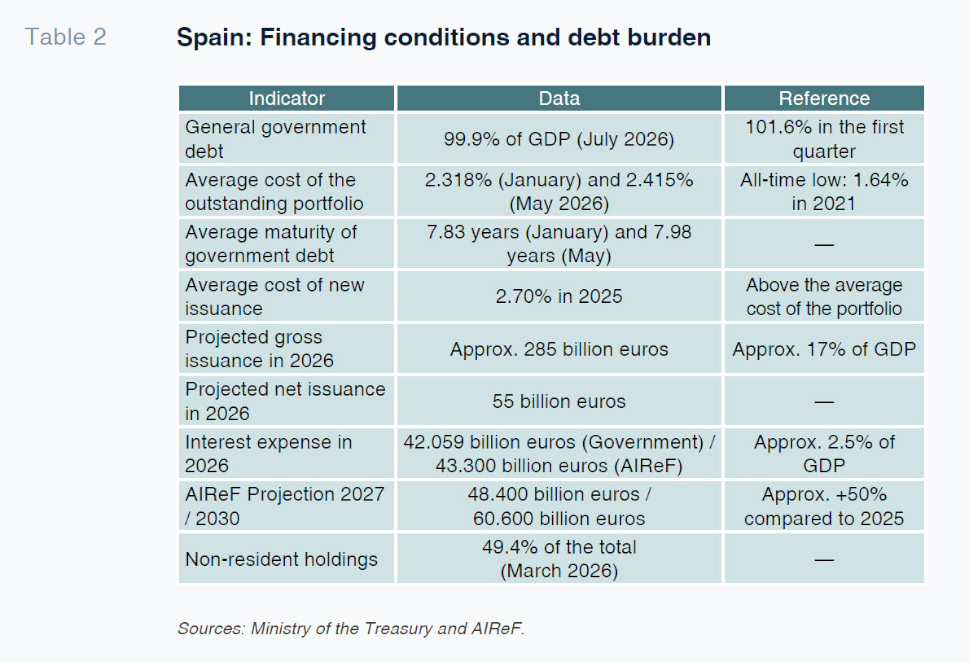
The second is that the Spanish paradox lies in the ratio. The debt-to-GDP ratio is falling because nominal GDP is growing faster than the outstanding debt, but the cost of that debt relative to GDP is rising. Interest is paid in euros, not in percentage points of the ratio. AIReF estimates the cumulative cost between 2026 and 2030 at around 261,000 million euros and warns that, under current policies, the increase in the financial burden will prevent the deficit from falling below 3% in the coming years.
The third factor is the least discussed. 49.4% of the debt is held by non-residents, a proportion that has grown as the Bank of Spain reduced its position. This investor base is broader and deeper, but also more sensitive to relative comparisons. Demand for Spanish debt is exceptional today because Spain offers higher growth than its partners with a contained spread. This appeal is relative and, therefore, reversible if either of these two factors changes. A recent development illustrates this. Yields on 12-month Treasury bills rose above 3% at the auctions on October 6 and 13, 2026—two-year highs. The short end of the curve, which reacts most quickly, is already pricing in the new conditions.
What does sustainability mean when the margin is narrow?
The literature on debt sustainability distinguishes between solvency and liquidity, but that distinction is less clear-cut than it suggests. A government is solvent if the present value of its future primary surpluses covers its debt. Since those surpluses are hypothetical and the discount rate depends on the market’s belief in them, solvency incorporates an expectation about itself. Therein lies the fundamental analytical problem. If investors believe the debt is sustainable, they demand a low premium; the cost remains below nominal growth, and the debt is effectively sustainable. If they stop believing this, the premium rises, the cost exceeds growth, and the debt is no longer sustainable. These are two equilibria, and the economy can be in either one based on the same fundamentals.
This is not a new observation. What has changed in 2026 is the distance between these two equilibria. During the decade of negative interest rates, the margin was so wide that any reasonable shock left the economy in the favorable equilibrium. With the spread between cost and growth near zero, an overall fiscal buffer virtually exhausted, and central banks withdrawn from the market, the margin has narrowed. Fragility is now the norm, not an adverse scenario. This leads to two implications worth emphasizing. The first concerns how risk is assessed. While sustainability had a wide margin, it was sufficient to monitor the level of debt. With narrow margins, what matters is sensitivity: how much the trajectory deteriorates in the face of a deviation in growth, interest rates, or the primary balance. A country with debt at 100% of GDP and a long average maturity is in a better position than one with 90% debt and concentrated maturities. The indicator that matters is not the level, but the derivative.
The latter affects fiscal policy. In a narrow-margin environment, the credibility of the medium-term path ceases to be a rhetorical issue and becomes a financial asset with measurable value. The French case demonstrates this in a negative way: what the market penalizes is not the stock of debt, but the absence of a credible mechanism to correct its trajectory. In Spain, AIReF’s repeated recommendation to present a medium-term fiscal strategy and the draft budget should be interpreted in this light, rather than as a procedural formality.
Final considerations
The prophecy about a debt market collapse has been repeated for so long that it has lost its informative value. That is precisely why it is important to distinguish clearly between a warning and a symptom. What happened in 2026 is not a sovereign debt crisis. There have been no defaults, no restructurings, and no loss of market access for any developed-market issuer. Auctions have been fully subscribed. Demand for Spanish debt remains outstanding.
What has happened is something else entirely. The market has begun to discriminate among sovereign issuers based on fiscal governance criteria, in an environment where there is no longer an institutional buyer to cushion that discrimination. The term premium has once again become a price with informative content after a decade in which it was, to a large extent, a managed variable.
For Spain, the conclusion is neither reassuring nor alarmist; it calls for caution. The average maturity of nearly eight years provides a window for adjustment that few countries have, and that window is a real asset. But a window is not a solution: it is borrowed time whose usefulness depends entirely on what is done during it. The interest burden will grow by about 50% through 2030 without any political decision being made and without the intervention rate rising by a single basis point.
The relevant question, therefore, is not whether Spain’s debt is sustainable, because it is today. The question is what leeway will remain to respond to the next shock once the debt service has absorbed the portion of the budget that currently allows for a response.
Francisco Rodríguez Fernández. University of Granada and Funcas